Why you cannot just subtract your age
An at-birth average cannot be turned into remaining years by subtracting someone's age. The calculation at 65 includes only people who reached 65; the at-birth measure also includes earlier deaths. ONS therefore reports remaining life expectancy separately at each age. Source: ONS guide to life tables.
A real example makes the distinction clear. The UK's 2022–2024 period estimates were 79.1 years at birth for males and 18.7 additional years at age 65. For females, they were 83.0 at birth and 21.2 additional years at 65. These are population estimates using that period's mortality rates, not personal forecasts. Source: ONS national life tables, released December 2025.
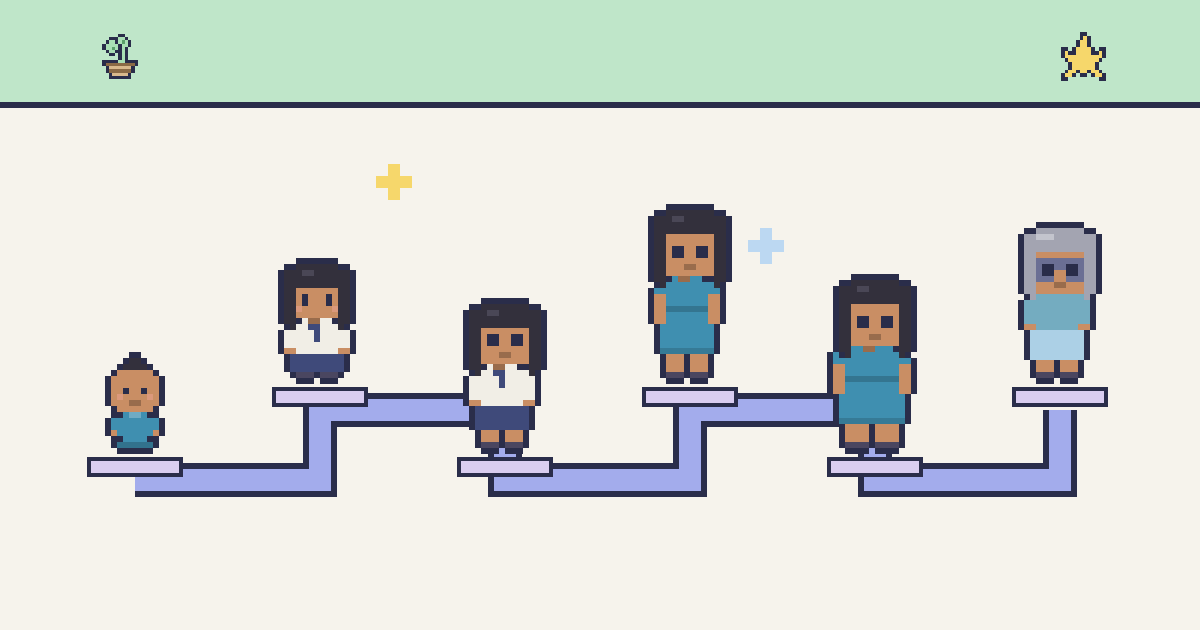
Four fictional pixel biographies
Consider four entirely invented completed lives lasting 40, 60, 80 and 100 years. Their average lifespan is 70 years: add 280 years and divide by four. This small example illustrates arithmetic; it is not a real life table or a model of the app.
Now ask about the characters who reached 65. Two did: the characters whose lives lasted 80 and 100 years. From 65 onward, they lived another 15 and 35 years. Their average remaining time was 25 years, not the five years obtained by subtracting 65 from 70.
Nothing was added to anyone's lifespan. The question selected a different group. That is what makes the result initially surprising: the information that someone has already reached an age changes the calculation.
One average cannot draw the whole curve
A life table also tracks how many members of a hypothetical population survive to successive ages. ONS calls this quantity lₓ; comparing survivor counts at two ages gives a conditional survival probability. Source: ONS guide, numbers surviving. A survival curve plots that pattern, giving more context than one average.
Even our four fictional biographies have an average of 70 with nobody living exactly 70 years. A different invented group could share that average while having much more similar lifespans. The average alone does not tell us how spread out the stories are.
Years of life and years in good health
Health measures add another dimension. WHO's healthy life expectancy, or HALE, adjusts years of life for time spent in different health states and their severity. It expresses an equivalent number of years in full health, rather than a birthday when illness begins. Source: WHO HALE definition and method.
England's ONS estimates for 2022–2024 show why averages also need an inequality lens. Male healthy life expectancy at birth was 49.8 years in the most deprived tenth of areas and 69.2 in the least deprived tenth. ONS measures years in self-reported good health; these estimates are labelled official statistics in development. They describe areas, not every resident or the effect of moving between them. Published confidence intervals express uncertainty around the estimates; they are not a range of possible lifespans for one person. Source: ONS, April 2026 release.
Those definitions differ from WHO's HALE, so the figures should not be treated as interchangeable. Both invite a richer question than how long: what are those years like? A pixel biography can make that question personal; population evidence helps us see the wider conditions around it.
FOLLOW YOUR CURIOSITY
Sources & further reading
- ONS: Guide to interpreting period and cohort life tables ↗
Defines remaining life expectancy at a specified age and hypothetical survivor counts used for conditional survival probabilities.
- ONS: National life tables, UK, 2022–2024 ↗
Released 10 December 2025. Period estimates: males 79.1 years at birth and 18.7 remaining at 65; females 83.0 and 21.2, respectively.
- WHO: Healthy life expectancy (HALE) ↗
Defines equivalent years in full health and adjustments for health-state severity.
- ONS: Healthy life expectancy by national area deprivation, 2022–2024 ↗
Released 15 April 2026. England male HLE at birth: 49.8 years in the most deprived decile and 69.2 in the least deprived. Uses self-reported general health; official statistics in development.
Sources and game details checked on 27 October 2026. Suggest a correction.